Two lattices, one twist
Lay one sheet of atoms on top of another and rotate it by a small angle \(\theta\). In some regions the atoms of the two sheets sit on top of each other; a little further on they fall between each other; further still they line up again. That slow alternation is a moiré pattern, and its period is far larger than the spacing \(a\) of the atoms themselves:
$$L \;=\; \frac{a}{2\sin(\theta/2)} \;\approx\; \frac{a}{\theta}.$$For graphene, \(a = 0.246\) nm. At \(\theta = 1.08^\circ\) the moiré period is about 13 nm, and one moiré cell holds roughly eleven thousand carbon atoms. An electron moving through the bilayer now feels a new, slowly varying landscape on top of the atomic one.
At this particular angle, the "magic angle", the electrons' kinetic energy nearly vanishes: the bands become almost flat, interactions between electrons dominate, and the material can become insulating or superconducting depending on how many electrons it holds. The same geometry, with other two-dimensional crystals, is now used to build arrays of quantum emitters and qubit candidates — which is where the calculations in the panel below come in.
The figure shows the relation above. Drag along it, or drag the pattern at the top of the page; both set the same angle.
+More — in my workTwisted hBN as an array of artificial atoms
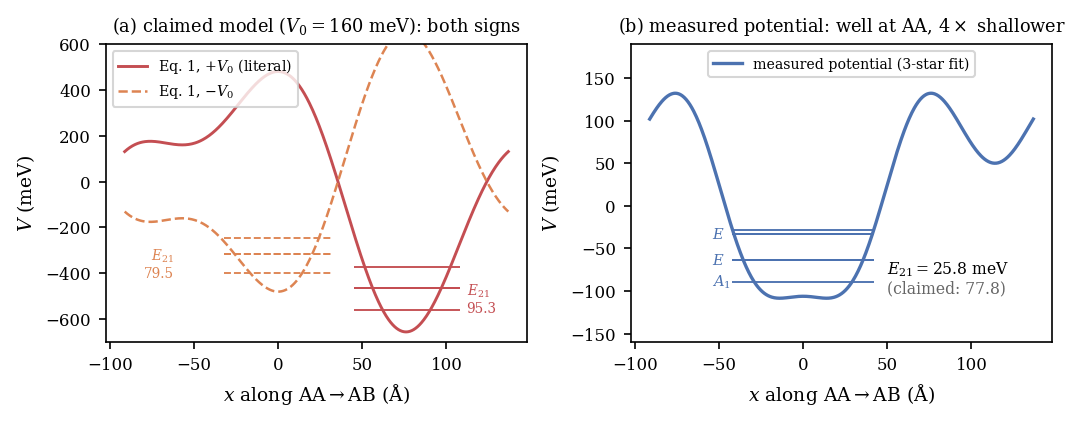
A recent proposal treats twisted hexagonal boron nitride as a lattice of identical "artificial atoms": each moiré cell would trap an electron in a deep, smooth well. The proposal rests on a fitted model of the moiré potential.
I recomputed the potential directly with density-functional theory at twenty-one stacking registries. The well is three to four times shallower than assumed (\(V_0 = 40\) meV), and the functional form the proposal uses is forbidden by the symmetry of the stack. A follow-up calculation of how fast the trapped states relax shows they cannot serve as orbital qubits (Chapter 5).
A junction is a nonlinear inductor
Join two superconductors through a thin barrier and a supercurrent flows with no voltage across it. Its size depends on the difference \(\varphi\) between the quantum phases of the two sides, and when the phase changes in time, a voltage appears. These are the two Josephson relations:
$$I = I_c\, f(\varphi), \qquad V = \frac{\hbar}{2e}\,\frac{d\varphi}{dt}.$$Together they make the junction behave like an inductor whose inductance depends on the current through it — a nonlinear inductor, and the one ingredient that turns a resonant circuit into a qubit.
For an insulating tunnel barrier, \(f(\varphi) = \sin\varphi\). In graphene, and in other weak links where electrons cross ballistically with transmission probability \(\tau\), the relation is skewed towards larger phase:
$$f(\varphi) \;\propto\; \frac{\sin\varphi}{\sqrt{1-\tau\sin^2(\varphi/2)}}.$$The skew is not cosmetic. Expanding the junction's energy around its minimum, \(U \propto \tfrac12\varphi^2 + \bigl(\tfrac{\tau}{32}-\tfrac{1}{24}\bigr)\varphi^4 + \dots\), the quartic term — which makes the levels of a qubit unequally spaced — shrinks as \(\tau\) grows. A transparent junction gives a less anharmonic qubit: \(\alpha/\alpha_{\text{tunnel}} = 1 - 3\tau/4\).
+More — in my workjosim-cpr-bridge
Circuit designers simulate junctions classically in JoSIM; qubit designers need the quantum spectrum. I wrote a small, tested bridge that takes any current–phase relation used in JoSIM — sinusoidal, transparency-skewed, or tabulated — and carries it unchanged to the qubit side: potential, Hamiltonian, levels, anharmonicity, three-wave mixing and a loss estimate.
It is checked against analytic limits and against the JoSIM v2.7 binary. Johannes Delport, the lead developer of JoSIM, is a collaborator on the repository, and a native generalized junction element for JoSIM itself is in discussion.
c₄/c₂ = τ/16 − 1/12 · 7/7 physics checks · 5/5 JoSIM regressions
Listening to a junction with microwaves
Shine microwaves of angular frequency \(\Omega\) on a junction and pass a steady current through it. Over some ranges of current, the phase locks to the drive and advances by a whole number of turns per cycle. While it is locked the voltage cannot change, so the current–voltage curve develops flat steps at
$$V_n = n\,\frac{\hbar\Omega}{2e}.$$These are Shapiro steps. They depend only on frequency and fundamental constants, which is why they once defined the volt.
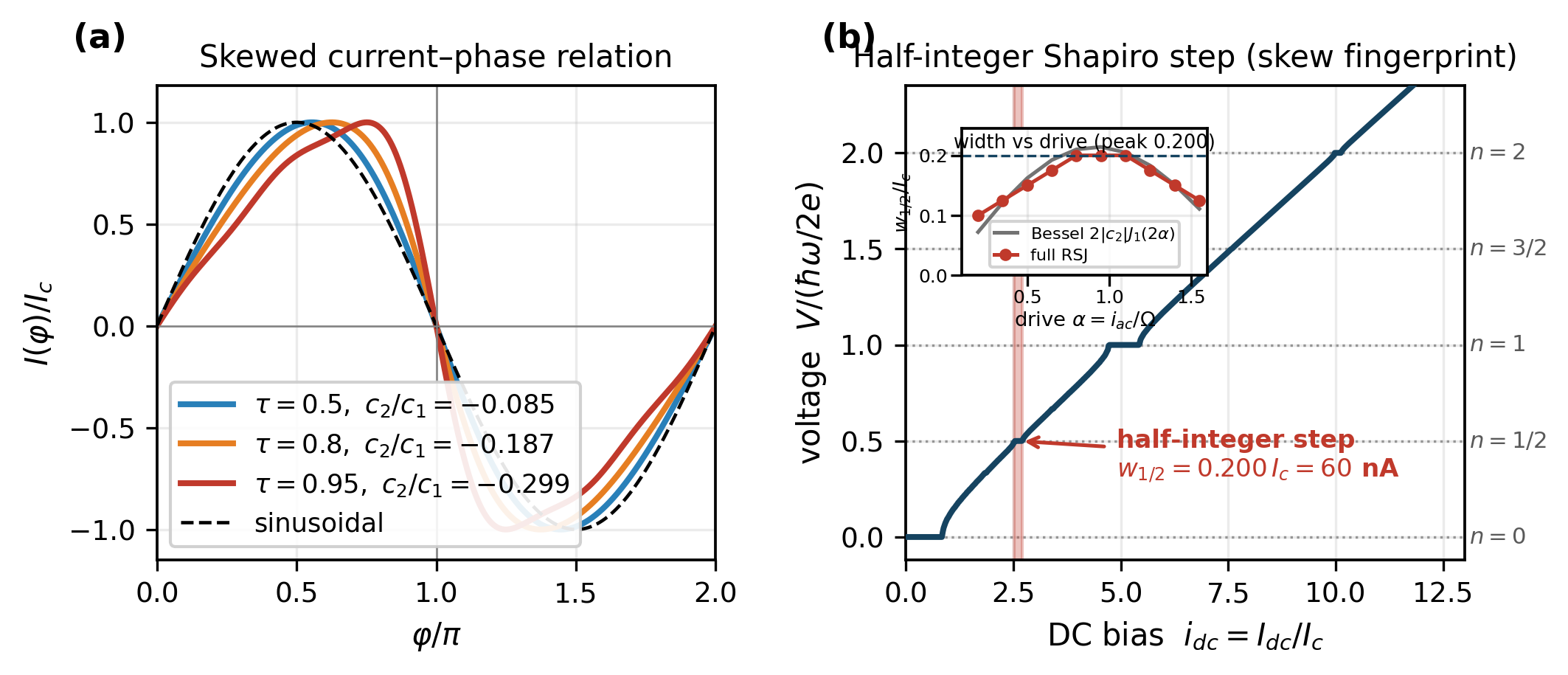
A sinusoidal junction gives steps at whole numbers \(n\). A skewed junction (Chapter 2) contains a second harmonic, \(\sin 2\varphi\), and that harmonic can lock at half the voltage: half-integer steps appear. Their width grows with the transmission, so a half step is a fingerprint of the current–phase relation.
The figure is computed in your browser from the resistively shunted junction model,
$$\frac{d\varphi}{dt} = i_{dc} + i_{ac}\sin\Omega t - f(\varphi),$$with currents in units of \(I_c\) and time in units of the junction's characteristic time. Raise \(\tau\) and watch the step at \(n = \tfrac12\) open.
+More — in my workMagic-angle graphene junctions in a sub-THz cavity
I built a modular simulation of a magic-angle graphene junction placed in a photonic-crystal cavity and driven at sub-terahertz frequency — material, cavity, junction and qubit as separate, cross-checked modules. The half step is a usable fingerprint: in that study, with τ = 0.8 and drive amplitude iac = 3.5, it is 0.200 Ic wide (60 nA), and its temperature dependence turns it into an electron thermometer. (The figure above uses different drive settings.)
A companion study draws the limits. The step measures transparency, not mechanism: trapped flux in an asymmetric loop also makes half steps, and which purely electrical measurements can tell the two apart is worked out separately.
A qubit is the bottom of a ladder
Put a capacitor across a junction and you have an oscillator whose restoring force comes from the junction. Its quantum description has two energy scales — the charging energy \(E_C\) of the capacitor and the Josephson energy \(E_J\) of the junction:
$$H = 4E_C\,(n - n_g)^2 - E_J\cos\varphi .$$Here \(n\) counts the electron pairs that have crossed the junction and \(n_g\) is an offset charge set by the surroundings. Because the cosine is not a parabola, the levels are not equally spaced, and the lowest two can be driven without disturbing the rest: that pair is the qubit.
The ratio \(E_J/E_C\) decides how well it works. When it is small, every level depends strongly on \(n_g\), so a stray electron anywhere nearby shifts the qubit frequency. Raising \(E_J/E_C\) flattens the levels exponentially — the idea behind the transmon — while the anharmonicity falls only slowly, towards \(-E_C\).
The figure diagonalises \(H\) in the charge basis as you move the slider.
+More — in my workFrom one transmon to a chip
A complete design flow, from layout to logical qubit: a transmon and its readout resonator drawn in Qiskit Metal, lumped values turned into \(E_J\), \(E_C\) and coupling, dispersive readout, relaxation and dephasing, a leakage-suppressing DRAG pulse, a two-qubit CZ gate, a five-qubit layout exported to GDS, and the logical error of a repetition code against distance.
The same Hamiltonian with a graphene junction gives a gatemon, whose \(E_J\) is tuned by a gate voltage rather than a magnetic flux.
What a qubit forgets, and how fast
A qubit loses information in two ways. It can give its energy away and fall to the ground state — relaxation, with time constant \(T_1\). Or it can keep its energy but lose track of its phase, because its frequency wanders — dephasing, with time \(T_\varphi\). The phase memory that matters for computation combines both:
$$\frac{1}{T_2} = \frac{1}{2T_1} + \frac{1}{T_\varphi}.$$A coherence budget lists every mechanism that contributes to these rates, estimates each one from the physics of the device, and sums them. The useful output is not the total but the ranking: which mechanism sets the limit, and what it would take to remove it.
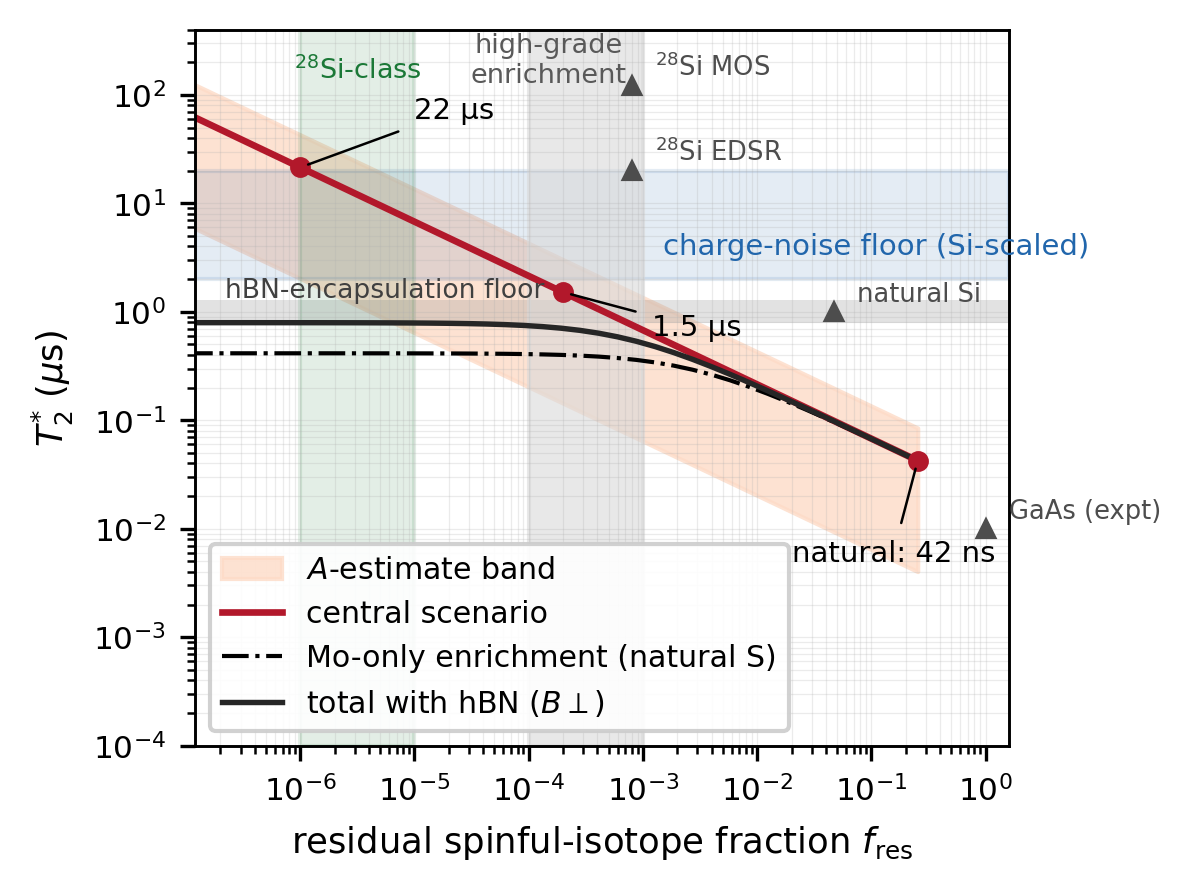
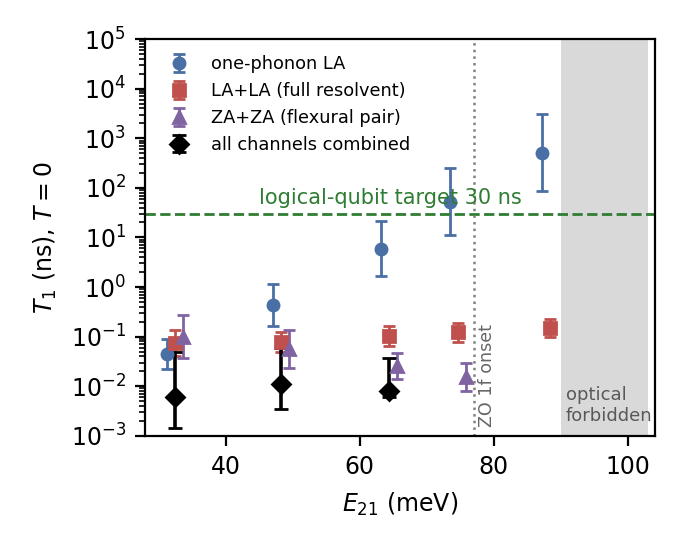
Two budgets from my work show the two possible endings. For hole spins in twisted MoS₂ (left), the dominant noise comes from nuclear spins. Isotope purification of the host removes them — until the nuclear spins of the hBN encapsulation, which cannot be purified away, set a floor near a microsecond. For orbital states in twisted hBN (right), relaxation by emitting two phonons sets \(T_1\) at a few picoseconds, far short of the 30 ns a logical qubit would need, and no parameter in reach closes the gap.
+More — in my workPreprint and repositories
The MoS₂ budget is published as a preprint. The hBN relaxation calculation combines one-phonon, two-phonon and flexural channels, and is calibrated against the known relaxation of phosphorus donors in silicon.
Sending entanglement far
Photons in optical fibre are lost exponentially with distance, and a quantum state cannot be copied and amplified. To share entanglement over hundreds of kilometres, a repeater chain splits the distance into short segments, entangles each segment separately, and joins neighbouring links by entanglement swapping until the two ends are connected.
The segments do not succeed at the same time. A link that is ready must wait in a quantum memory for its neighbours, and while it waits it decoheres. A cutoff discards any link that has waited longer than \(t_{\text{cut}}\) and starts it again.
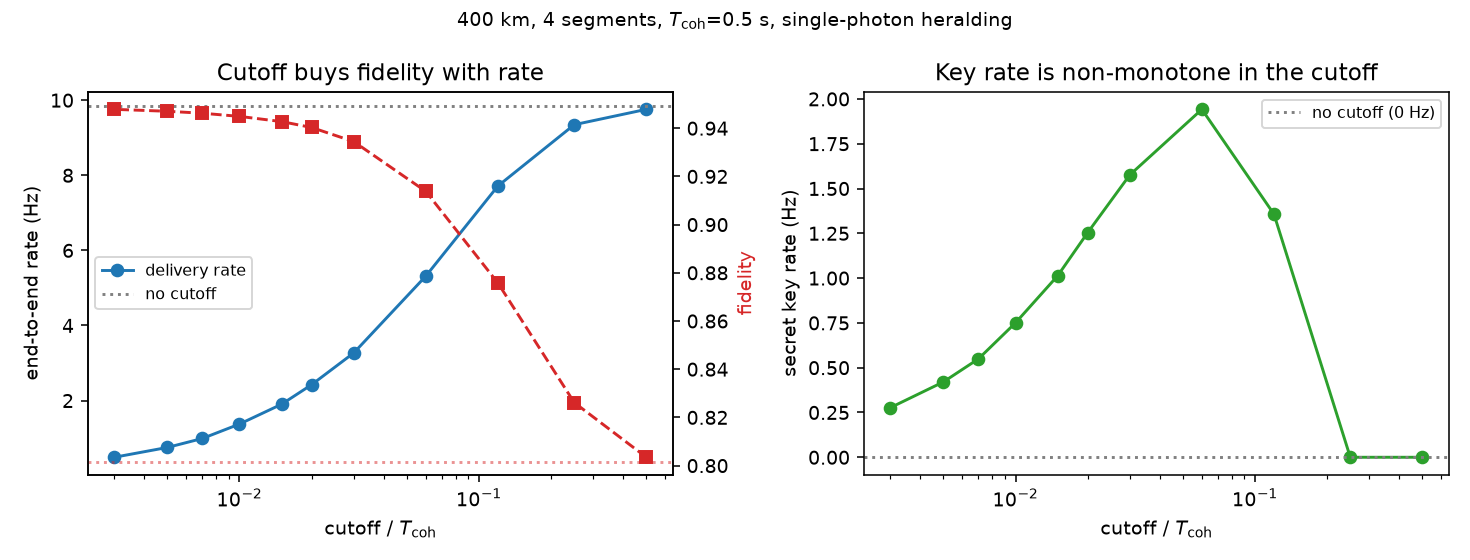
The cutoff is a trade. A short one keeps only fresh, high-fidelity links but throws many away; a long one keeps links but lets them degrade. A secret key can only be distilled above a fidelity threshold, so the key rate is not monotone in the cutoff: with no cutoff at all it can be zero, and an intermediate cutoff gives the best rate.
In the four-segment, 400 km chain below, running without a cutoff gives no key. A cutoff of 0.06 of the memory coherence time gives 1.94 key bits per second.
+More — in my workDo richer cutoff policies help?
This reproduces the established result that a single, uniform cutoff is optimal for this chain (Li, Coopmans and Elkouss, 2021) and asks whether richer policies help: cutoffs that grow with the span of a link, or a gate on accumulated decoherence. With paired, source-coupled sampling, neither beats the uniform cutoff; the decay gate is dominated rather than offering a trade-off.
The generation layer is validated against an exact closed form, and the note was revised after an adversarial referee pass whose overturned claims are kept on record.
When the answer is no
A calculation that rules something out is as useful as one that works, provided its reasoning can be followed and checked. The ones below each started as a promising idea. They are kept public, with the numbers that settled them.
The method behind all of them is the same. Every result a conclusion depends on is computed twice, by two different routes — a closed form against a numerical solver, a continuum model against an atomistic one, a second code written from the paper rather than from the first. Where the routes disagree, the disagreement is the finding. AI coding assistants are used for development and for adversarial review; each repository states how its results were checked.
AC confinement does not protect a bilayer-graphene dot qubit
A modulated well looked like a dynamical sweet spot against charge noise. The gain rested on a period-averaging step that full Floquet evolution invalidates.
bilayer-graphene-qd-qubitAntidot defects in graphene are not a qubit platform
A pre-registered geometry scan found a favourable ordering of defect states at one size; it reverses at the next. A finite-size artifact.
holey-graphene-antidot-qubitTwisted-hBN artificial atoms cannot hold orbital qubits
Two-phonon relaxation sets T₁ at about 6–11 ps, against the 30 ns required.
twisted-hbn-orbital-qubit-limitA 300-logical-qubit moiré processor does not close
Per-bond control needs energy precision of micro-electronvolts to a tenth of a milli-electronvolt, against about 15 meV of site disorder; no wiring scheme reaches the required pitch.
moire-300-logical-qubit-feasibilitySub-THz readout of a magic-angle junction has three hard limits
The Shapiro fingerprint measures transparency, not mechanism; a quantum-geometric readout is ruled out; the Higgs mode is overdamped.
matbg-subthz-limitsThe "hardest" interaction range is not a converged number
For long-range Ising quenches, the range that maximises classical simulation cost moves with both system size and normalisation convention.
tfim-classical-cost
Preprints and software
Testing the twisted-hBN artificial-atom proposal by registry-resolved DFT: a symmetry-forbidden potential form, a three-to-fourfold-weaker well, and what survives
F. S. Bilgin, preprint, 2026.
Twisted bilayer MoS₂ cannot talk to light: a Γ-valley hole spin memory and its isotope-purification coherence budget
F. S. Bilgin, preprint, 2026.
The single-photon microwave loss of a moiré superconducting element: why the published geometry cannot measure it, and a two-device experiment that can
F. S. Bilgin, preprint, 2026.
josim-cpr-bridge: a classical-to-quantum current–phase-relation bridge for exotic Josephson junctions
F. S. Bilgin, software v0.1.0, 2026.